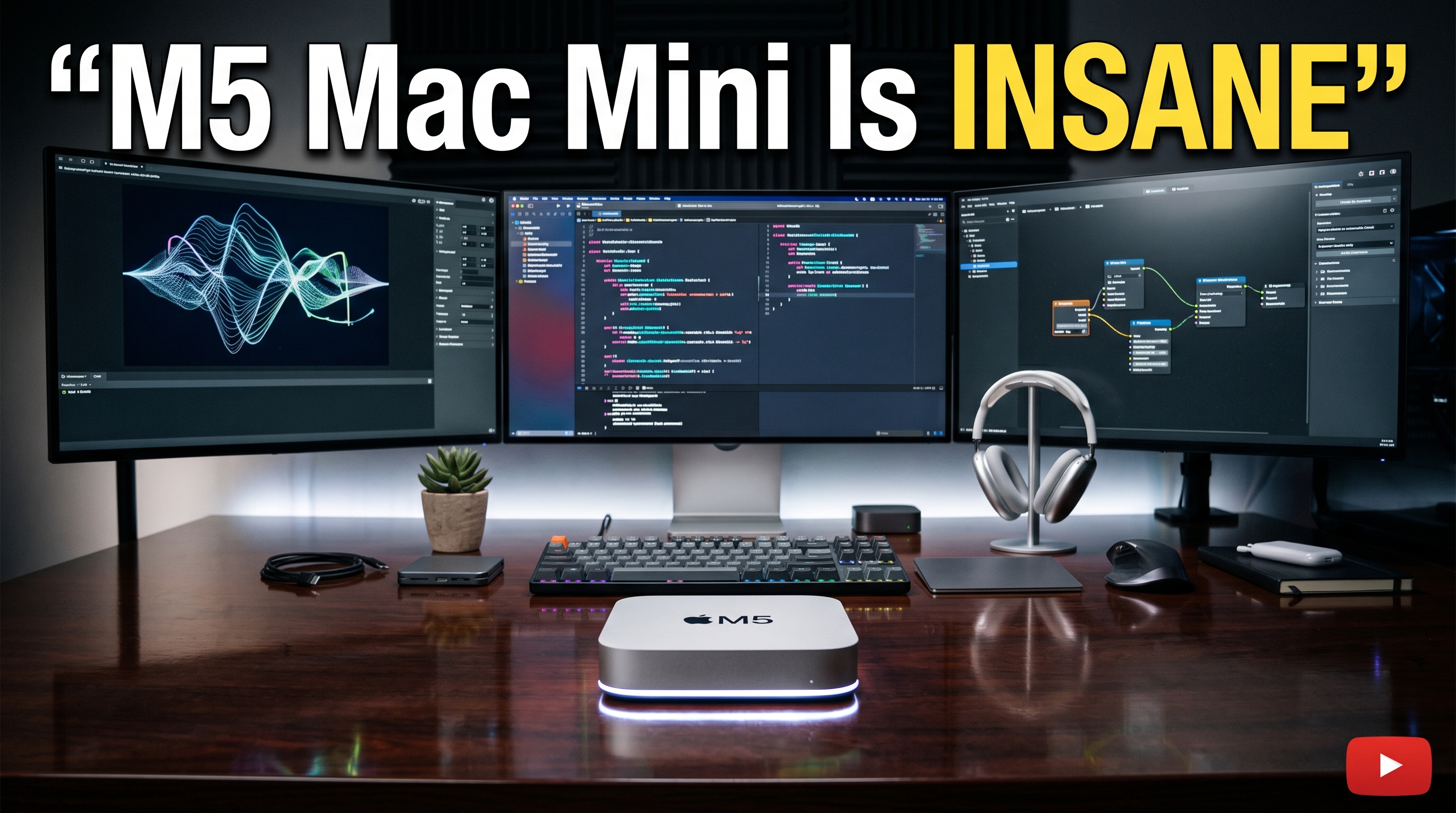
Apple didn’t just refresh the Mac mini with the M4 chip. It quietly turned the machine into one of the most practical desktop computers the company has ever made.
The redesign introduced in late 2024 finally gave the Mac mini an identity that felt modern again. Smaller footprint, cleaner thermals, stronger performance, and surprisingly aggressive pricing made it appealing to developers, creators, and even people replacing large Windows desktops.
Now attention is shifting toward the next version: the Mac mini M5.
Based on current leaks, hardware trends, and Apple’s recent direction with Apple Silicon, the M5 Mac mini looks less like a redesign and more like a serious performance refinement. And honestly, that’s probably the right move.
Apple Probably Won’t Touch the Design Again
The current Mac mini design is still new by Apple standards.
Apple spent more than a decade barely changing the physical shape of the Mac mini before introducing the redesigned M4 generation. Because of that, expecting another external redesign this soon doesn’t really make sense.
The M5 version will likely keep the same compact aluminum chassis, the same port layout, and yes, probably the same controversial power button placement underneath the device.
That might annoy some people, but realistically, Apple tends to keep desktop hardware designs around for years once manufacturing is optimized.
And there’s no urgent reason to change it.
The current Mac mini already solves most of the problems users had with older generations:
- better cooling
- smaller footprint
- quieter operation
- more premium build quality
- easier desk integration
For many developers and workstation users, the physical design is already “good enough.” What matters now is performance per watt, memory bandwidth, GPU capability, and AI acceleration.
That’s where the M5 matters.
The M5 Chip Looks Like a Serious Upgrade
The biggest story around the upcoming Mac mini isn’t the enclosure. It’s the silicon inside it.
Apple’s standard M-series chips have become surprisingly powerful over the last few generations, especially in single-core performance. The leaked M5 benchmarks continue that trend.
Early reports suggest the base M5 chip could deliver around:
- 4,200+ single-core Geekbench scores
- 17,000+ multi-core scores
- major GPU improvements over M4
Those numbers matter more than marketing slides.
For real-world workflows, strong single-core performance still affects a huge number of daily tasks:
- compiling code
- running local development servers
- browser-heavy workflows
- UI responsiveness
- Xcode performance
- scripting workloads
Apple has consistently dominated this area, and the M5 appears to push that even further.
What’s more interesting is how close the standard M5 reportedly gets to older high-end chips like the M1 Ultra and M2 Max in certain workloads. That’s a massive shift considering this is still Apple’s “base” desktop processor tier.
For many users, especially developers, that changes buying decisions completely.
A few years ago, serious local workloads almost forced you into expensive Mac Studio territory. Now a Mac mini may be enough for:
- Docker environments
- iOS development
- Android Studio
- AI-assisted coding tools
- video editing
- multiple external displays
- light machine learning workflows
That’s a pretty dramatic jump for Apple’s smallest desktop.
The M5 Pro Could Be the Real Sweet Spot
The standard M5 will probably satisfy most users, but the M5 Pro version is where things start getting genuinely impressive.
Leaks point toward massive multi-core gains and a much stronger GPU configuration compared to the current M4 Pro generation.
The interesting part is Apple’s evolving chip strategy.
In earlier generations, the jump from Pro to Max chips usually included large CPU differences. But with the M5 lineup, Apple seems more focused on scaling GPU power and memory bandwidth instead.
That means the M5 Pro may offer nearly the same CPU capability as higher-tier chips while costing substantially less.
For developers and professional users, that’s important.
A lot of workstation tasks today are CPU-bound long before they become GPU-limited:
- compiling projects
- virtualization
- backend workloads
- container orchestration
- local AI inference
- large codebase indexing
If the M5 Pro delivers near-Max CPU performance without requiring Mac Studio pricing, the Mac mini becomes extremely difficult to ignore.
And because Apple Silicon remains incredibly power efficient, all of this happens without the heat and fan noise you’d normally expect from a compact desktop.
Apple May Finally Push Higher Base Storage
One of the more believable rumors surrounding the M5 Mac mini involves storage changes.
Apple reportedly plans to move away from 256GB base configurations entirely for some Macs, especially as AI tooling and creative workloads continue growing.
That would make sense.
Modern development environments alone can consume huge amounts of space:
- Xcode installations
- Docker images
- Android SDKs
- local AI models
- virtual machines
- video assets
A 256GB machine in 2026 already feels restrictive.
The expected configuration changes look something like this:
Standard M5 Mac mini
- likely starts at 512GB storage
- 16GB unified memory baseline
- configurable up to 32GB RAM
M5 Pro Mac mini
- likely starts at 1TB storage
- higher memory bandwidth
- larger GPU configurations
- higher RAM ceiling
The downside is obvious.
Prices will probably increase.
Apple rarely upgrades base storage without adjusting pricing, so a $100 increase across the lineup feels realistic if these rumors are accurate.
Still, many users would probably accept that tradeoff if it eliminates the painfully small entry-level storage options.
AI Workloads Are Changing the Market
One reason the Mac mini has become unexpectedly popular again is the explosion of AI-assisted workflows.
Developers are now running tools locally that barely existed a couple of years ago:
- local LLMs
- AI coding assistants
- vector databases
- image generation models
- AI-powered automation tools
That demand is affecting the entire hardware industry.
RAM prices are climbing. NAND storage pricing is unstable. Supply chains are tighter because large AI infrastructure projects are consuming enormous amounts of hardware resources globally.
Apple isn’t isolated from any of this.
That’s part of the reason some analysts now believe the M5 Mac mini could arrive later than originally expected.
Earlier rumors pointed toward a WWDC 2026 launch, but supply constraints may push the release toward late 2026 instead.
At this point, October or November feels more realistic than a summer launch.
Should You Wait for the Mac mini M5?
That depends entirely on what you need today.
If you already own an M4 Mac mini, upgrading immediately probably won’t make much sense unless your workloads specifically need stronger GPU or multi-core performance.
The current generation is already extremely capable.
But if you’re still using:
- Intel Macs
- M1 systems
- older Windows desktops
- aging Linux workstations
then the M5 Mac mini could end up being one of the best value desktop machines Apple has released in years.
Especially for developers.
Apple’s strategy right now feels very clear: smaller machines, stronger chips, more AI acceleration, and fewer compromises in entry-level hardware.
And honestly, the Mac mini may benefit from that strategy more than any other Mac in the lineup.
It’s no longer the “cheap Mac.”
It’s becoming the practical one.